

À la Recherche du Trésor Perdu : L'IA comme Guide

Imaginez une carte ancienne, jaunie par le temps, avec un "X" marquant l'emplacement d'un trésor légendaire. Maintenant, imaginez qu'au lieu de suivre votre intuition, vous confiez cette quête à une intelligence artificielle. C'est exactement ce que nous allons réaliser aujourd'hui en utilisant l'apprentissage par renforcement, une branche passionnante du machine learning qui permet à un agent d'apprendre à prendre des décisions optimales.
Contrairement aux méthodes traditionnelles, notre algorithme n'aura aucune connaissance préalable de la carte. Il apprendra par essais-erreurs, exactement comme un véritable explorateur, mais à une vitesse que seul un ordinateur peut atteindre.
Définition apprentissage par renforcement
« En intelligence artificielle, plus précisément en apprentissage automatique, l'apprentissage par renforcement consiste, pour un agent autonome (robot, etc.), à apprendre les actions à prendre, à partir d'expériences, de façon à optimiser une récompense quantitative au cours du temps. »
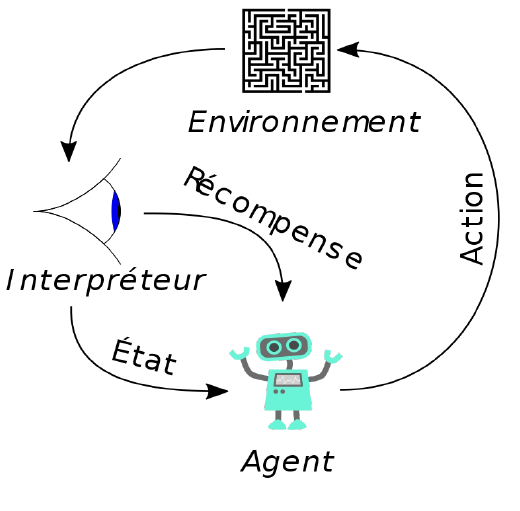
Qu'est-ce que l'Apprentissage par Renforcement ?
L'apprentissage par renforcement s'inspire directement de la façon dont les humains et les animaux apprennent. L'agent (notre explorateur IA) interagit avec un environnement (la carte au trésor) en effectuant des actions (se déplacer). Il reçoit des récompenses (points positifs ou négatifs) et ajuste sa stratégie pour maximiser le gain total.
Dans notre scénario :
État : Position sur la carte
Actions : Haut, Bas, Gauche, Droite
Récompense : +100 pour le trésor, -1 pour chaque pas (pour encourager l'efficacité)
Objectif : Trouver le chemin le plus court vers le trésor
Description générale
L’agent (robot) devra se déplacer de façon aléatoire au début et apprendre de ses erreurs pour connaître le chemin vers le trésor. L’agent pourra se déplacer sur les cases adjacentes à lui.
Il sera bloqué par des obstacles et pénalisé (réapparition et récompense négative) s’il est sur la même case qu’un piège et récompensé (réapparition et récompense positive) s’il est sur la même case qu’un trésor.
Implémentation en Python : Notre Carte au Trésor Moderne
# -*- coding: utf-8 -*-
import numpy as np
import pandas as pd
import time

from PIL import Image, ImageTk
import Tkinter as tk
import os

MENU_H = 400
MENU_W = 600
H_HEIGHT = 429
H_WIDTH = 758
PH_HEIGHT = 735
PH_WIDTH = 766
HELP_OPEN = False
PHELP_OPEN = False

def geoliste(g):
    r=[i for i in range(0,len(g)) if not g[i].isdigit()]
    return [int(g[0:r[0]]),int(g[r[0]+1:r[1]]),int(g[r[1]+1:r[2]]),int(g[r[2]+1:])]

def launch(event):
    window.withdraw()
    os.system('python rdt.py %(h)d %(w)d %(a)d %(t)d %(wa)s %(tr)s %(s)f' % {'h': SIMU_HEIGHT, 'w': SIMU_WIDTH, 'a' : SIMU_AGENT, 't' : SIMU_TREASURE, 'wa' : SIMU_WALLS, 'tr' : SIMU_TRAPS, 's' : SIMU_SPEED})
    window.deiconify()

def quit(event):
    window.quit()

def help_window(event):
    global HELP_OPEN
    if not HELP_OPEN:
       hwindow.deiconify()
       HELP_OPEN = True

def phelp_window(event):
    global PHELP_OPEN
    if not PHELP_OPEN:
       phwindow.deiconify()
       PHELP_OPEN = True

def parameter_window(event):
    window.withdraw()
    pwindow.deiconify()

def help_quit():
    global HELP_OPEN
    hwindow.withdraw()
    HELP_OPEN = False

def phelp_quit():
    global PHELP_OPEN
    phwindow.withdraw()
    PHELP_OPEN = False

def parameter_quit():
    pwindow.withdraw()
    window.deiconify()

def recupVariable(event):
    global SIMU_HEIGHT, SIMU_WIDTH, SIMU_AGENT, SIMU_TREASURE, SIMU_WALLS, SIMU_TRAPS, SIMU_SPEED
    SIMU_HEIGHT = pscale_height.get()
    SIMU_WIDTH = pscale_width.get()
    SIMU_SPEED = pscale_speed.get()
    try:
        SIMU_AGENT = int(pentry_agent.get())-1
        if SIMU_AGENT > SIMU_HEIGHT*SIMU_WIDTH or SIMU_AGENT < 1:
            SIMU_AGENT = 0
    except ValueError:
        SIMU_AGENT = 0
    try:
        SIMU_TREASURE = int(pentry_treasure.get())
        if SIMU_TREASURE > SIMU_HEIGHT*SIMU_WIDTH or SIMU_TREASURE < 1:
            SIMU_TREASURE = SIMU_HEIGHT*SIMU_WIDTH
    except ValueError:
        SIMU_TREASURE = SIMU_HEIGHT*SIMU_WIDTH
    SIMU_WALLS = pentry_walls.get()
    if SIMU_WALLS == '':
        SIMU_WALLS = ','
    SIMU_TRAPS = pentry_traps.get()
    if SIMU_TRAPS == '':
        SIMU_TRAPS = ','

    parameter_quit()

if __name__ == "__main__":
    SIMU_HEIGHT = 6
    SIMU_WIDTH = 4
    SIMU_AGENT = 0
    SIMU_TREASURE = SIMU_HEIGHT*SIMU_WIDTH
    SIMU_WALLS = ','
    SIMU_TRAPS = ','
    SIMU_SPEED = 0.5

    # Main menu window
    window = tk.Tk()
    window.title("The Treasure Hunt")
    window.resizable(width=False, height=False)
    canvas = tk.Canvas(window, bg='white',
                           height=MENU_H,
                           width=MENU_W)
    canvas._photobg = photobg = ImageTk.PhotoImage(file= "image/image_menu.png")
    canvas.create_image(0,0,anchor=tk.NW,image=photobg)
    canvas.pack()

    launch_button = tk.Button(canvas, text ='Launch simulation', width = 30)
    launch_button.place(relx=0.5,rely=0.7,anchor='center')

    parameter_button = tk.Button(canvas, text ='Parameters', width = 30)
    parameter_button.place(relx=0.5,rely=0.8,anchor='center')

    quit_button = tk.Button(canvas, text ='Quit', width = 30)
    quit_button.place(relx=0.5,rely=0.9,anchor='center')

    help_button = tk.Button(canvas, text ='Help', width = 4)
    help_button.place(relx=0.9,rely=0.9,anchor='center')

    # Center the window
    MENUX = (window.winfo_screenwidth()-MENU_W)//2
    MENUY = (window.winfo_screenheight()-MENU_H)//2
    window.geometry("%dx%d%+d%+d" % (MENU_W,MENU_H,MENUX,MENUY))

    # Button event
    launch_button.bind('<Button-1>', launch)
    parameter_button.bind('<Button-1>', parameter_window)
    quit_button.bind('<Button-1>', quit)
    help_button.bind('<Button-1>', help_window)

    # Help window
    hwindow = tk.Toplevel(window)
    hwindow.title("Help")
    hwindow.geometry("%dx%d%+d%+d" % (H_WIDTH, H_HEIGHT, MENUX-H_WIDTH, MENUY+(MENU_H//2)-(H_HEIGHT//2)))
    hwindow.resizable(width=False, height=False)

    hcanvas = tk.Canvas(hwindow,height=H_HEIGHT,width=H_WIDTH)
    hcanvas._photohelp = photohelp = ImageTk.PhotoImage(file= "image/help.png")
    hcanvas.create_image(0,0,anchor=tk.NW,image=photohelp)
    hcanvas.pack()

    hwindow.withdraw()

    # Parameter window
    pwindow = tk.Toplevel(window)
    pwindow.title("Parameter")
    pwindow.geometry("%dx%d%+d%+d" % (MENU_W,MENU_H,MENUX,MENUY))
    pwindow.resizable(width=False, height=False)

    pscale_width = tk.Scale(pwindow,variable=SIMU_WIDTH, orient='horizontal', from_=1, to=10, length=100, label='Width')
    pscale_width.set(SIMU_WIDTH)
    pscale_width.place(relx=0.2,rely=0.1,anchor='center')

    pscale_height = tk.Scale(pwindow,variable=SIMU_HEIGHT, orient='vertical', from_=1, to=10, length=100, label='Height')
    pscale_height.set(SIMU_HEIGHT)
    pscale_height.place(relx=0.1,rely=0.3,anchor='center')

    pbutton_done = tk.Button(pwindow, text ='Done', width = 30)
    pbutton_done.place(relx=0.5,rely=0.8,anchor='center')
    pbutton_done.bind('<Button-1>', recupVariable)

    tk.Label(pwindow, text="Choose Agent's case between 1 & Height x Width").place(relx=0.3, rely=0.1,anchor='w')
    pentry_agent = tk.Entry(pwindow, width=2)
    pentry_agent.place(relx=0.5,rely=0.15,anchor='center')

    tk.Label(pwindow, text="Choose Treasure's case between 1 & Height x Width").place(relx=0.3, rely=0.25,anchor='w')
    pentry_treasure = tk.Entry(pwindow, width=2)
    pentry_treasure.place(relx=0.5,rely=0.3,anchor='center')

    tk.Label(pwindow, text="Enter a list for Wall's cases, \nbetween 1 & Height x Width and with ',' as separator").place(relx=0.3, rely=0.4,anchor='w')
    pentry_walls = tk.Entry(pwindow, width=30)
    pentry_walls.place(relx=0.5,rely=0.5,anchor='center')

    tk.Label(pwindow, text="Enter a list for Trap's cases, \nbetween 1 & Height x Width and with ',' as separator").place(relx=0.3, rely=0.6,anchor='w')
    pentry_traps = tk.Entry(pwindow, width=30)
    pentry_traps.place(relx=0.5,rely=0.7,anchor='center')

    pscale_speed = tk.Scale(pwindow,variable=SIMU_SPEED, orient='vertical', from_=0.05, to=0.5, length=100, label='Delay time', resolution=0.05)
    pscale_speed.set(SIMU_SPEED)
    pscale_speed.place(relx=0.1,rely=0.6,anchor='center')

    pbutton_help = tk.Button(pwindow, text ='Help', width = 4)
    pbutton_help.place(relx=0.9,rely=0.9,anchor='center')
    pbutton_help.bind('<Button-1>', phelp_window)

    pwindow.withdraw()

    # Parameter Help window
    phwindow = tk.Toplevel(window)
    phwindow.title("Help")
    phwindow.geometry("%dx%d%+d%+d" % (PH_WIDTH, PH_HEIGHT, MENUX+MENU_W, MENUY+(MENU_H//2)-(PH_HEIGHT//2)))
    phwindow.resizable(width=False, height=False)
    canvas_phelp = tk.Canvas(phwindow,height=PH_HEIGHT,width=PH_WIDTH)
    canvas_phelp._photophelp = photophelp = ImageTk.PhotoImage(file= "image/final_help_parameter.png")
    canvas_phelp.create_image(0,0,anchor=tk.NW,image=photophelp)
    canvas_phelp.pack()
    phwindow.withdraw()

    # Help window protocol (cross)
    hwindow.protocol('WM_DELETE_WINDOW', help_quit)
    pwindow.protocol('WM_DELETE_WINDOW', parameter_quit)
    phwindow.protocol('WM_DELETE_WINDOW', phelp_quit)

    # Launch the menu window
    window.mainloop()
L'Algorithme Q-Learning : Le Cœur de Notre Explorateur IA
Le Q-Learning est un algorithme d'apprentissage par renforcement sans modèle qui apprend une fonction de valeur d'action (Q-function). Cette fonction estime la "qualité" d'une action dans un état donné.
Version et bibliothèques utilisées
Version Python : 2.7.12
Bibliothèques :
- PIL pour l’implémentation des images
- Tkinter pour l’implémentation des widgets (boutons,etc,…)
- numpy pour la gestion de l’aléatoire
- pandas pour la construction de la Q-table
- time pour gérer le délai entre chaque action
- sys pour récupérer les données de la simulation via les arguments en commandes
- os pour lancer la simulation comme une commande
Applications Modernes au-delà de la Chasse au Trésor
L'apprentissage par renforcement ne se limite pas aux jeux ou aux métaphores historiques. Cette technologie révolutionne des domaines concrets :
-
Robotique Autonome : Navigation dans des environnements complexes
-
Optimisation de Trafic : Contrôle intelligent des feux de circulation
-
Trading Algorithmique : Optimisation de portefeuilles d'investissement
-
Recommandation de Contenu : Personnalisation des flux multimédias
-
Gestion d'Énergie : Optimisation de la consommation dans les smart grids
Le Futur de l'Exploration Algorithmique
Notre petite chasse au trésor illustre un principe fondamental : l'IA apprend en interagissant avec son environnement. Les algorithmes modernes comme le Deep Q-Learning (qui combine réseaux de neurones et Q-learning) ou les Policy Gradients permettent aujourd'hui de résoudre des problèmes infiniment plus complexes.
Ce que nous avons créé aujourd'hui est une micro-représentation des systèmes qui pilotent les voitures autonomes, battent les champions mondiaux aux échecs ou au Go, et optimisent les chaînes d'approvisionnement globales.
Pour Aller Plus Loin
Si cette introduction à l'apprentissage par renforcement vous a passionné, voici quelques pistes :
-
Implémentez des obstacles mobiles
-
Ajoutez plusieurs trésors avec différentes valeurs
-
Testez différents algorithmes (SARSA, Deep Q-Network)
-
Augmentez la complexité de la carte
Programme principal
Vous pouvez télécharger le code source du programme principal et les différents fichiers du savoir en cliquant sur le lien ci-dessous.
Catégories
Savoirs les plus récents
-
Comprendre les Promesses en JavaScript : Guide Complet pour Débutants
JavaScript -
Créer des Tableaux HTML Professionnels : Guide Complet pour Débutants et Experts
HTML5 -
Maîtrisez le Formatage HTML : Guide Complet des Balises de Texte Sémantiques
HTML5 -
Le Langage HTML : Fondement Essentiel du Web Moderne
HTML5 -
PHP DateTime : créez, comparez et formatez des dates
PHP